 |
|
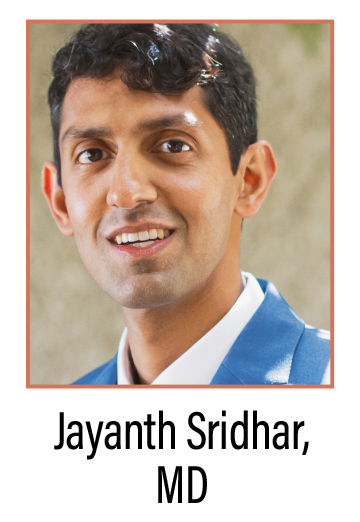
Bio Dr. Sridhar is an associate professor of clinical ophthalmology at Bascom Palmer Eye Institute, Miami. DISCLOSURES: Dr. Sridhar is a consultant to Alcon, DORC, Genentech/Roche and Regeneron Pharmaceuticals. |
The recent story of Vaibhav Duggal, a third-year medical student who died by suicide after facing a school disciplinary process for reported unprofessional behavior, including following a patient on Instagram shortly after an encounter, is first and foremost a tragedy.¹ A young person is gone, a family is grieving, and the institutional details will likely be debated for some time. But beyond the most devastating part of the story lies a broader issue medicine must increasingly confront: What does it mean when a physician, trainee or other health professional follows a patient on social media?
For most of modern medicine, professional boundaries were easier to visualize. The clinical relationship occurred in the exam room, the hospital, the operating room or by telephone. Physicians had personal lives, but those lives weren’t usually visible to patients in real time, outside of chance encounters in the community. Social media has changed that. A patient can find a doctor’s Instagram account within seconds. A doctor can see a patient’s public posts just as easily. A follow request, direct message, “like” or comment may feel casual online, but it doesn’t necessarily feel casual within the patient-physician relationship.
That distinction matters because medicine isn’t a relationship between equals in the ordinary social sense. Patients disclose intimate information, undergo physical examinations and place trust in physicians at vulnerable moments. Even when a physician’s intent is innocent, the patient may experience online contact differently. A follow after a clinical encounter may be interpreted as curiosity, friendliness, marketing, flirtation, surveillance or something more intrusive. The ambiguity itself is the problem. Boundaries exist not only to prevent intentional misconduct, but also to prevent situations where intent and perception diverge.
Professional guidance already recognizes this concern. The American College of Physicians and the Federation of State Medical Boards have advised physicians to keep professional and personal online identities separate and avoid “friending” or contacting patients through personal social media.² The AMA Code of Medical Ethics similarly emphasizes that physicians who interact with patients online must maintain appropriate boundaries and should consider separating personal and professional content.³ Medical communication, when it occurs electronically, should take place within an established patient-physician relationship, with patient consent, and in a way that can be documented in the medical record.
The practical reality, however, is becoming more complicated. Younger physicians and trainees have grown up in a world where social media is part of daily life. Patients routinely search for physicians online. Physicians use Instagram, TikTok, LinkedIn, X and other platforms for education, advocacy, recruitment, networking and practice building. The answer can’t be that doctors should disappear from social media. The answer is that boundaries must be clearer.
A reasonable framework starts with basic rules: Don’t initiate personal social media contact with patients; don’t follow them from a personal account; don’t send friend requests; and don’t review their profiles without a clear clinical, legal or safety-related reason. If patients send medical questions through social media, redirect them to the patient portal, office phone or another approved clinical channel. If educational content is posted online, it should remain general rather than individualized.
Institutions also need to teach this explicitly. “Be careful online” is not enough. Trainees need concrete guidance for common scenarios: a patient follows them; sends a message; comments on a post; appears on a dating app; or overlaps with their local community. These are no longer rare hypotheticals.
The simplest test remains useful: Would the same interaction feel appropriate if it occurred in person immediately after the clinic visit, with the patient fully aware of the power differential? If not, it probably doesn’t belong on personal social media either. A follow is not always “just a follow.” In medicine, it can carry meaning beyond what the physician intended. RS
REFERENCES
1. Block F. A medical student took his own life. His parents blame the school. https://www.thefp.com/p/a-medical-student-took-his-own-life-his-parents-blame-the-school. Accessed August 7, 2026.
2. ACP Online. New recommendations offer physicians ethical guidance for preserving trust in patient-physician relationships and the profession when using social media. https://www.acponline.org/acp-newsroom/new-recommendations-offer-physicians-ethical-guidance-for-preserving-trust-in-patient-physician. Accessed August 7, 2026.
3. AMA Code of Medical Ethics. https://policysearch.ama-assn.org/policyfinder/detail/E2.3.2%20?uri=%2FAMADoc%2FEthics.xml-E-2.3.2.xml. Accessed August 7, 2026.