Take-home points
|
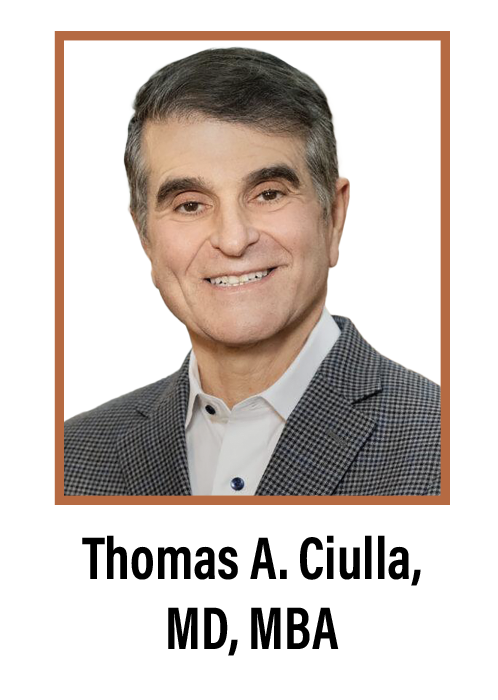 |
Bio Dr. Ciulla is president and CEO of Ikarovec Limited, a U.K.-based gene therapy company developing dual-pathway treatments for retinal diseases. He is also an adjunct clinical professor of ophthalmology at Indiana University School of Medicine. He discloses financial interests in Ikarovec, Nanoscope and Viridian. |
Intravitreal anti-vascular endothelial growth factor injections have transformed the management of nAMD over the past two decades; however, the burden of frequent, indefinite treatment remains a formidable challenge. Real-world data consistently demonstrate that patients receive fewer injections than those in controlled trials, resulting in suboptimal visual outcomes.1,2 Patients on continuous fixed-interval dosing tend to maintain better long-term visual acuity, while those receiving infrequent dosing demonstrate less improvement.3,4
Gene therapy offers a paradigm-shifting alternative: a single administration that converts retinal cells into durable biofactories, continuously producing endogenous anti-VEGF protein and potentially eliminating the need for repeated injections. Three gene therapy candidates for nAMD have now advanced to Phase II or III development: surabgene lomparvovec (RegenxBio/AbbVie); ixoberogene soroparvovec (Adverum Biotechnologies/Eli Lilly); and 4D-150 (4D Molecular Therapeutics). Each employs distinct AAV vector systems, delivery routes and transgene strategies. This review summarizes the current status and most recent data for these programs.
Surabgene Lomparvovec (ABBV-RGX-314)
Surabgene lomparvovec (sura-vec, formerly ABBV-RGX-314) uses a NAV AAV8 vector to deliver a transgene encoding a ranibizumab-like anti-VEGF monoclonal antibody fragment via subretinal injection. A Phase I/IIa, open-label, dose-escalation study demonstrated positive safety and efficacy with a single subretinal administration, showing stability of best-corrected visual acuity and central retinal thickness up to two years, with the therapy well tolerated at all five dose levels.5,6 In a long-term follow-up study, sura-vec demonstrated a durable treatment effect with stable or improved vision up to four years at dose levels similar to the pivotal trials.7 An additional Phase II pharmacodynamic bridging study confirmed favorable tolerability at one year in 60 treated participants at pivotal-level doses, with no drug-related serious adverse events, stabilized or improved vision and anatomy, and meaningful reductions in anti-VEGF injections.7 A Phase II fellow eye sub-study, presented in June 2025, further demonstrated a 93-percent reduction in treatment burden at 12 months, again with no drug-related serious adverse events.7
These results supported initiation of two pivotal trials: ATMOSPHERE (Phase IIb/III, U.S.) evaluating sura-vec at two dose levels (6.4×10¹⁰ and 1.3×10¹¹ GC/eye) versus ranibizumab, and ASCENT (Phase III, global) evaluating sura-vec at the same two dose levels versus aflibercept. Both employ subretinal delivery, with primary endpoints based on non-inferiority in mean change from baseline BCVA at 54 weeks and one year, respectively. In October 2025, RegenxBio announced completion of enrollment across both trials, with over 1,200 participants randomized at more than 200 sites globally, representing the largest gene therapy program conducted to date in nAMD.8 Topline pivotal data are expected in Q4 2026. The program reflects a robust strategic alliance between RegenxBio and AbbVie, which includes a $370 million upfront payment with up to $1.38 billion in additional milestones and a 50/50 U.S. profit-sharing arrangement.7
RegenxBio has also evaluated suprachoroidal delivery of sura-vec in the Phase II AAVIATE trial. At the highest dose level (1×10¹² GC/eye), over 50 patients demonstrated an 80-percent reduction in annualized anti-VEGF injection rates and a 50-percent injection-free rate at six months, with no cases of intraocular inflammation reported in the cohort receiving prophylactic topical steroid eye drops.9
 |
|
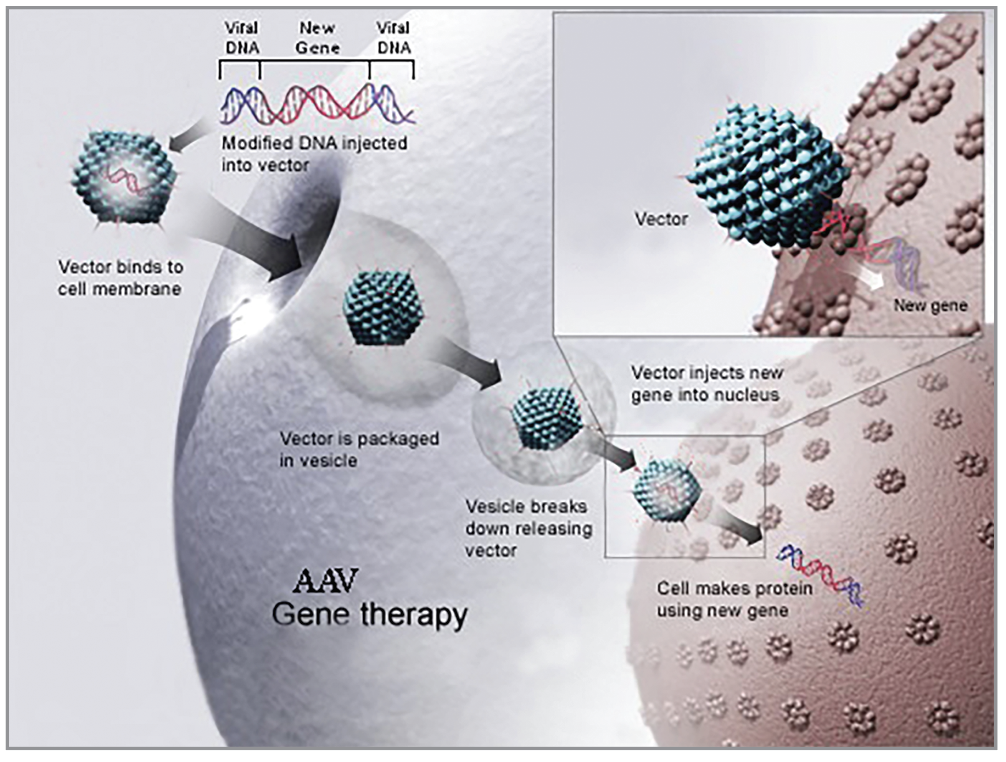
Figure 1. An illustration of the adeno-associated viral vector mechanism of action (cell entry, transgene delivery, protein expression). (Image credit: George Church, Creative Commons, https://creativecommons.org/licenses/by-sa/3.0/deed.en) |
Ixoberogene Soroparvovec (Ixo-vec)
Ixoberogene soroparvovec (ixo-vec, formerly ADVM-022) employs the AAV2.7m8 capsid for intravitreal delivery of a transgene expressing aflibercept. Its intravitreal route of administration distinguishes it from subretinally delivered candidates.
The Phase I OPTIC trial evaluated two dose levels (2×10¹¹ and 6×10¹¹ vg/eye) in previously treated nAMD patients with high injection burden. The 2×10¹¹ vg/eye dose demonstrated a favorable benefit-risk profile with four-year data showing an 86 percent cumulative annualized reduction in anti-VEGF injections (from 9.9 to 1.4 mean annualized injections),10 maintained BCVA and CRT, and no cases of hypotony, vasculitis, retinitis, choroiditis or vascular occlusions.11 All inflammation resolved by year one and was responsive to local corticosteroids.
The Phase II LUNA trial (N=60) investigated two doses (2×10¹¹ and 6×10¹⁰ vg/eye) with enhanced corticosteroid prophylaxis. Two-year results presented at FLORetina in December 2025 demonstrated sustained anatomic control and visual acuity preservation in both dose groups. At two years, mean annualized anti-VEGF injections were reduced by approximately 89 to 90 percent across both doses (from a baseline of ∼10 injections per year to 0.9–1.1 post-treatment).10 Between 46 and 61 percent of participants received one or fewer total injections cumulatively through two years. Among a lower-burden subgroup, 75 to 100 percent received one or fewer injections over the same interval.11 The dose ultimately selected for Phase III (6×10¹0 vg/eye) with local prophylaxis alone showed no new inflammation after week 30, and IOP remained stable.10 Aqueous humor aflibercept concentrations remained durable across all dose levels, with overlapping expression patterns observed for up to five years in OPTIC.10
A patient preference survey at week 52 found that 100 percent of participants receiving the Phase III dose with steroid eyedrops alone preferred ixo-vec over their prior treatments, would want treatment in their fellow eye, and would recommend the therapy to family or friends.10
The ARTEMIS Phase III trial is the first of two planned registrational studies for ixo-vec in nAMD, evaluating a single intravitreal administration of ixo-vec (6×10¹0 vg/eye) compared to aflibercept (2 mg) every eight weeks in both treatment-naïve and previously treated patients (N=284). The trial employs an enrichment design, with three aflibercept loading doses administered pre-randomization and anti-VEGF response assessed after the second dose, with difluprednate prophylaxis and a primary endpoint of non-inferiority in mean BCVA change (average of weeks 52 and 56) using a -4.5 letter margin. In September 2025, Adverum announced screening closed ahead of expectations, with topline data accelerated to Q1 2027.12 In October 2025, Eli Lilly announced a definitive agreement to acquire Adverum, providing the resources and infrastructure to advance ixo-vec through global registration and potential commercialization.13 A second Phase III trial, AQUARIUS, was anticipated to initiate in Q4 2025.11
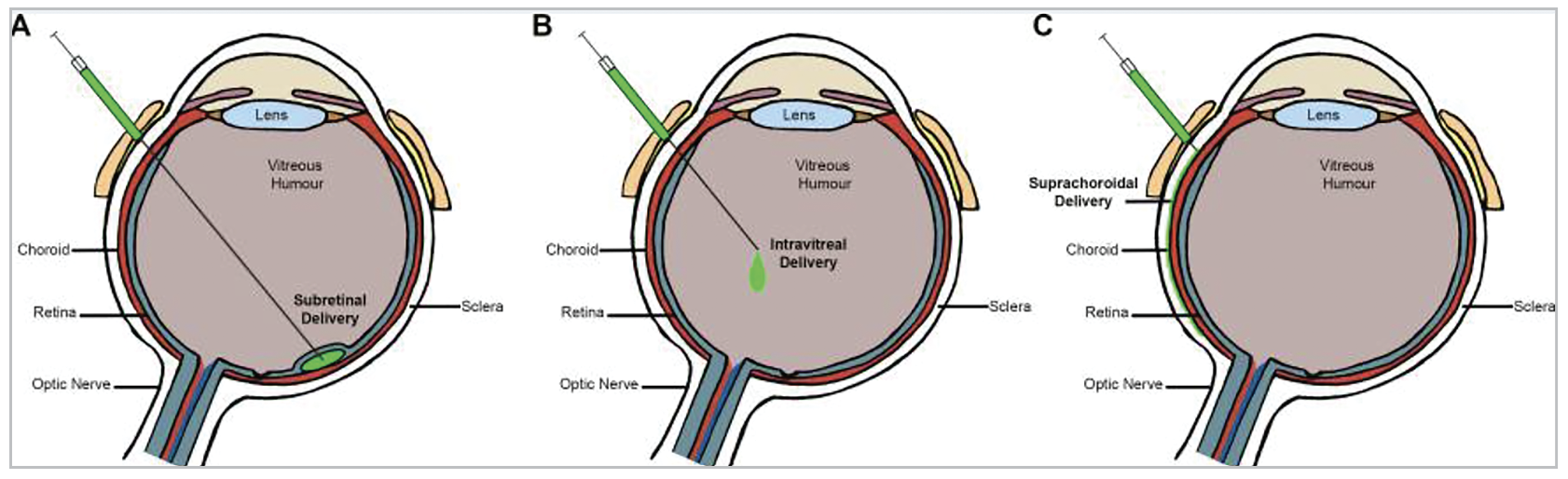 |
| Figure 2. Schematic figure of the eye demonstrating the possible routes of delivery to introduce viral vectors into the eye. (From Guimaraes TAC, Georgiou M, Bainbridge JWB, Michaelides M. Br J Ophthalmol 2021;105:2:151-157. Licensed for reuse.) |
4D-150
4D-150 (4D Molecular Therapeutics) employs a proprietary evolved intravitreal AAV vector, R100, to deliver a dual-transgene cassette expressing both aflibercept and a VEGF-C inhibitory RNAi, thereby targeting four angiogenic factors: VEGF-A; -B; and -C and placental growth factor.6 This bicistronic approach differentiates 4D-150 from the other candidates in development.
The PRISM Phase I/II trial has generated progressively maturing data across three cohorts with distinct disease populations: a Phase I/IIa cohort with severe, recalcitrant disease (n=24); a broader Phase IIb cohort (n=30); and a Phase IIb recently diagnosed subgroup (n=15) most comparable to the Phase III population. Phase IIb 52-week results presented at the Angiogenesis meeting in February 2025 demonstrated improved visual acuity, sustained anatomic control and meaningful treatment burden reduction. In the overall Phase IIb population receiving the Phase III dose (3×10¹0 vg/eye), there was an approximately 83-percent reduction in anti-VEGF injections compared to projected on-label aflibercept Q8W, with 70 percent of participants receiving zero or one supplemental injection through 52 weeks. Among recently diagnosed patients, the reduction reached approximately 94 percent, with 87 percent receiving zero or one injection.14
Longer-term PRISM data reported in November 2025 extended these findings through 1.5 years (Phase IIb) and two years (Phase I/IIa), with visual acuity and anatomy comparable to Q8W aflibercept in the randomized Phase IIa cohort. Treatment burden reductions were maintained across all cohorts and all six-month intervals, supporting durable disease control. In the recently diagnosed subgroup, treatment burden reduction was 92 percent at 1.5 years, with 73 percent of patients remaining injection-free. A consistent dose response favoring the Phase III dose of 3×10¹⁰ vg/eye over the 1×10¹⁰ vg/eye dose was observed across all cohorts and time points.15 The safety profile remained favorable, with only two of 71 patients (2.8 percent) experiencing transient, mild (1+) inflammation at the Phase III dose, no new inflammation after the first 28 weeks, extending through 3.5 years of follow-up, and 99 percent of patients completing the steroid prophylaxis taper on schedule and remaining completely off steroids.15
The global Phase III program comprises two identically designed, multicenter, randomized, double-masked trials: 4FRONT-1 (treatment-naïve, North America, N=480) and 4FRONT-2 (treatment-naïve and recently diagnosed treatment-experienced, global, N=480). Both compare a single intravitreal injection of 4D-150 (3×10¹⁰ vg/eye) to aflibercept 2 mg Q8W after three loading doses. The primary endpoint is non-inferiority in BCVA change from baseline at 52 weeks, powered with an approximately four-letter margin for global regulatory standards. The trial design incorporates an enrichment strategy, randomizing only confirmed aflibercept responders and excluding outlier baseline anatomy to reduce variability.16
In February 2026, 4DMT announced completion of enrollment for 4FRONT-1, with over 500 patients randomized in approximately 11 months.17 Topline data from 4FRONT-1 are expected in H1 2027. 4FRONT-2 enrollment is on track for completion in H2 2026, with topline data expected in H2 2027. 4DMT has also partnered with Otsuka for development in the Asia-Pacific region, and 4D-150 has received FDA RMAT and EMA PRIME designations, and is in active talks with Japan’s PMDA.15,16
Conclusions and future directions
The gene therapy pipeline for nAMD has reached an inflection point, with three candidates now in pivotal Phase III development, large-scale enrollment completed or nearing completion, and topline data anticipated between Q4 2026 and H2 2027. These programs collectively represent distinct strategic approaches: subretinal delivery with an AAV8 vector encoding a ranibizumab-like anti-VEGF antibody fragment (sura-vec); intravitreal delivery via AAV2.7m8 encoding aflibercept (ixo-vec); and intravitreal delivery via an evolved R100 capsid encoding aflibercept and an anti-VEGF-C transgene (4D-150). Because trial designs, comparator arms, and baseline treatment burden differ across studies, direct cross-trial comparisons of injection reduction should be interpreted cautiously. Major pharma investment, the AbbVie alliance with RegenxBio and Eli Lilly’s acquisition of Adverum, further underscore commercial confidence in this therapeutic class.
Challenges remain, including the management of intraocular inflammation through optimized steroid prophylaxis, potential variability in transgene expression levels across patients, and the long-term durability of therapeutic effect beyond the multi-year follow-up reported thus far. Nevertheless, the consistent findings across these programs, including substantial reductions in injection burden, maintained visual acuity and anatomy, and manageable safety profiles, strongly support the potential for gene therapy to transform nAMD treatment from a paradigm of chronic, indefinite injections to a single-session intervention with durable therapeutic benefit. RS
REFERENCES
1. Ciulla TA, Huang F, Westby K, et al. Real-world outcomes of anti-vascular endothelial growth factor therapy in neovascular age-related macular degeneration in the United States. Ophthalmol Retina 2018;2:7:645–653.
2. Ciulla TA, Hussain RM, Pollack JS, Williams DF. Visual acuity outcomes and anti-VEGF therapy intensity in neovascular AMD patients: a real-world analysis of 49,485 eyes. Ophthalmol Retina 2020;4:1:19–30.
3. Peden MC, Suñer IJ, Hammer ME, Grizzard WS. Long-term outcomes in eyes receiving fixed-interval dosing of anti-VEGF agents for wet AMD. Ophthalmology 2015;122:4:803–808.
4. Moshfeghi AA, Pitcher JD, Lucas G, et al. Visual acuity outcomes in patients receiving frequent treatment of neovascular AMD in clinical practice. J Vitreoretin Dis 2021;5:3:221–226.
5. Campochiaro PA, Avery R, Brown DM, et al. Gene therapy for neovascular age-related macular degeneration by subretinal delivery of RGX-314: a phase 1/2a dose-escalation study. Lancet 2024;403:10436:1563–1573.
6. Rowe LW, Ciulla TA. Gene therapy for non-hereditary retinal disease: age-related macular degeneration, diabetic retinopathy, and beyond. Genes 2024;15:6:720.
7. REGENXBIO. Corporate presentation. January 2026. Data from Phase II Bioreactor Bridging study (data cut October 21, 2024), Phase II Fellow Eye sub-study (data cut May 26, 2025), and AbbVie strategic partnership.
8. REGENXBIO Inc. REGENXBIO announces completion of enrollment in pivotal trials of subretinal surabgene lomparvovec for wet AMD. Press release. October 6, 2025.
9. REGENXBIO Inc. REGENXBIO announces interim data from Phase II AAVIATE trial of ABBV-RGX-314 for the treatment of wet AMD using suprachoroidal delivery. Press release. 2024.
10. Wykoff CC. Ixo-vec gene therapy for nAMD: clinical progress from the LUNA Phase 2 trial. Presented at FLORetina; December 2025. Includes OPTIC 4-year and LUNA 2-year results.
11. Khanani AM, Boyer DS, Wykoff CC, et al. Safety and efficacy of ixoberogene soroparvovec in neovascular age-related macular degeneration in the United States (OPTIC): A prospective, two-year, multicentre phase 1 study. EClinicalMedicine 2024;67:102394.
12. Adverum Biotechnologies. Adverum Biotechnologies announces completion of screening for pivotal Phase 3 ARTEMIS trial of ixo-vec for wet age-related macular degeneration. Press release. September 22, 2025.
13. Eli Lilly and Company, Adverum Biotechnologies. Lilly to acquire Adverum Biotechnologies. Press release. October 24, 2025.
14. Pieramici D. Phase 2b population extension cohort evaluating 4D-150 in neovascular AMD: 52-week results. Presented at Angiogenesis meeting; February 2025.
15. 4D Molecular Therapeutics. 4DMT announces positive long-term data from Phase 1/2 PRISM clinical trial in wet AMD supporting 4D-150’s potential as a backbone therapy. Press release. November 6, 2025.
16. 4D Molecular Therapeutics. Corporate presentation. January 2026.
17. 4D Molecular Therapeutics. 4DMT completes enrollment for 4FRONT-1 Phase 3 clinical trial of 4D-150 in wet AMD. Press release. February 9, 2026.