 |
|
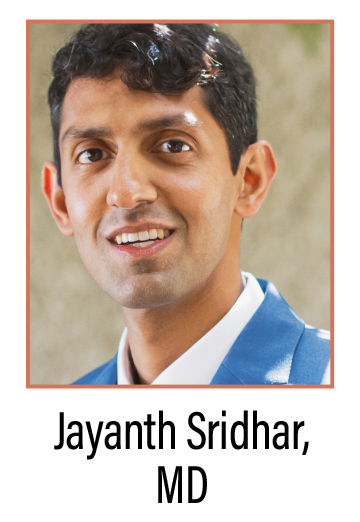
Bio Dr. Sridhar is an associate professor of clinical ophthalmology at Bascom Palmer Eye Institute, Miami. DISCLOSURES: Dr. Sridhar is a consultant to Alcon, DORC, Genentech/Roche and Regeneron Pharmaceuticals. |
For most of modern medicine and science, the pathway from discovery to dissemination has followed the same route: A study is conducted, a manuscript is written, and the work undergoes peer review before appearing in a scientific journal. This system has long served as the backbone of academic credibility. Peer review functions as a form of collective scrutiny: Methods are examined (and ideally reproduced by other groups), statistical analyses are questioned and conclusions are tempered before publication.
In principle, this process acts as a filter against flawed reasoning, overstated claims and methodological weaknesses. The result isn’t perfect science, but science that has at least survived structured criticism from experts in the field.
Yet the pace of modern communication has shifted dramatically. Social media platforms now allow researchers to distribute ideas, figures and preliminary findings instantly to thousands of readers. In some cases, new data appear online within hours of being generated, bypassing months, or sometimes years, of editorial review.
For clinicians and trainees accustomed to the traditional cadence of academic publishing, this creates a strange hybrid environment. Moreover, for the new generation of rising doctors, social media dissemination may represent the norm rather than the exception. Important insights may circulate widely long before they appear in print, while established journals feel increasingly slow in comparison.
 |
Peer review still provides several advantages that remain difficult to replicate elsewhere. Independent reviewers act as a quality control mechanism, forcing authors to defend their methodology, clarify assumptions and justify conclusions. Statistical errors, overlooked confounders, and interpretive overreach are frequently caught during this process.
Equally important is validation; publication in a peer-reviewed journal signals that the work has been evaluated by knowledgeable colleagues rather than simply amplified by an algorithm. In fields such as medicine, where claims can influence clinical practice and patient decision-making in an era of increasing patient autonomy, this gatekeeping function remains essential.
At the same time, the traditional system carries real drawbacks. The process is slow, expensive and often opaque. Journals rely heavily on unpaid labor from editors and peer reviewers, even as major publishers maintain substantial profit margins. Authors frequently pay article processing charges or page fees to publish within what many describe as the “academic rat race,” and institutions pay again through journal subscriptions. Months of revision cycles can delay the communication of results that may already be circulating informally. Reviewers can be arbitrary and may bring their own biases against certain institutions or author groups. From the perspective of younger researchers navigating career timelines, the system can feel both inefficient and inequitable.
Social media occupies the opposite extreme. Information spreads rapidly, discussion occurs in real time, and a single well-designed figure can reach a global audience overnight. These platforms can democratize scientific conversation, allowing trainees, clinicians and researchers from outside traditional academic hierarchies to engage directly with new work.
However, speed comes at a cost. Without structured review, incorrect interpretations can propagate quickly, nuance may disappear and popularity can substitute for rigor. The result is a communication ecosystem where valuable insight must compete with the noise of premature conclusions.
Scientific discourse is therefore entering a transitional phase. Peer-reviewed journals remain the most reliable mechanism for validating research, but they no longer monopolize attention or influence. Social media accelerates discussion but can’t fully replace structured evaluation.
The likely future isn’t one system replacing the other, but an uneasy coexistence—rapid online conversation paired with slower, more deliberate validation. In that environment, the challenge for physicians and researchers will be learning how to move between both worlds, engaging with new ideas quickly while still demanding the rigor that good science requires. At the same time, journals and peer-reviewed publications may need to evolve their processes to remain relevant in a faster-moving scientific landscape. RS