Take-home points
|
 |
Bios Dr. Watane is a second-year vitreoretinal surgery fellow at Tufts Medical Center and Ophthalmic Consultants of Boston. Dr. Bommakanti is an assistant professor of ophthalmology at Tufts University School of Medicine. |
Vascular endothelial growth factor suppression is the mainstay of treatment for neovascular age-related macular degeneration, diabetic macular edema and macular edema from retinal vein occlusion. For many of our patients, this has transformed blinding eye diseases into treatable conditions.
The most widely used treatment involves intravitreal injections every four to 16 weeks of antibodies or antibody fragments that block extracellular VEGF-A binding (as well as other growth factors such as VEGF-B, placental growth factor and angiopoietin-2, depending on the therapeutic agent that’s used).
Because patients often require many injections, real world outcomes that we see in our practices tend to fall short of clinical trial results due to the burdens of frequent clinic visits.¹
Consequently, there remains an unmet need for treatments offering increased efficacy and durability.
Why TKIs?
VEGF receptors belong to a class of molecules called receptor tyrosine kinases. Tyrosine kinase inhibitors are small molecules that act intracellularly, blocking the signal transduction cascade that occurs after VEGF and other growth factors bind to their extracellular receptors. The downstream activity of TKIs allows for greater suppression of VEGF and other cytokines implicated in retinal vascular disease. The receptors central to these agents are the three VEGF receptors (VEGFR-1, -2 and -3), which transduce signaling for VEGF-A, -B, -C, -D, -E and placental growth factor. Several investigational TKIs additionally inhibit platelet-derived growth factor receptor (PDGFR), fibroblast growth factor receptor (FGFR) and c-Kit, which may influence pericyte recruitment and vascular maturation.²
Free TKI is rapidly cleared from the vitreous, so these agents are paired with sustained-release or alternative-delivery platforms. Their small molecular weight (≤500 Da) and lipophilicity allow formulation in sustained-release vehicles, making them attractive candidates for chronic, relapsing retinal disease.³ The agents reviewed below are grouped by delivery route (intravitreal, suprachoroidal, periocular, topical and subcutaneous), with indications spanning nAMD, DME and NPDR.4
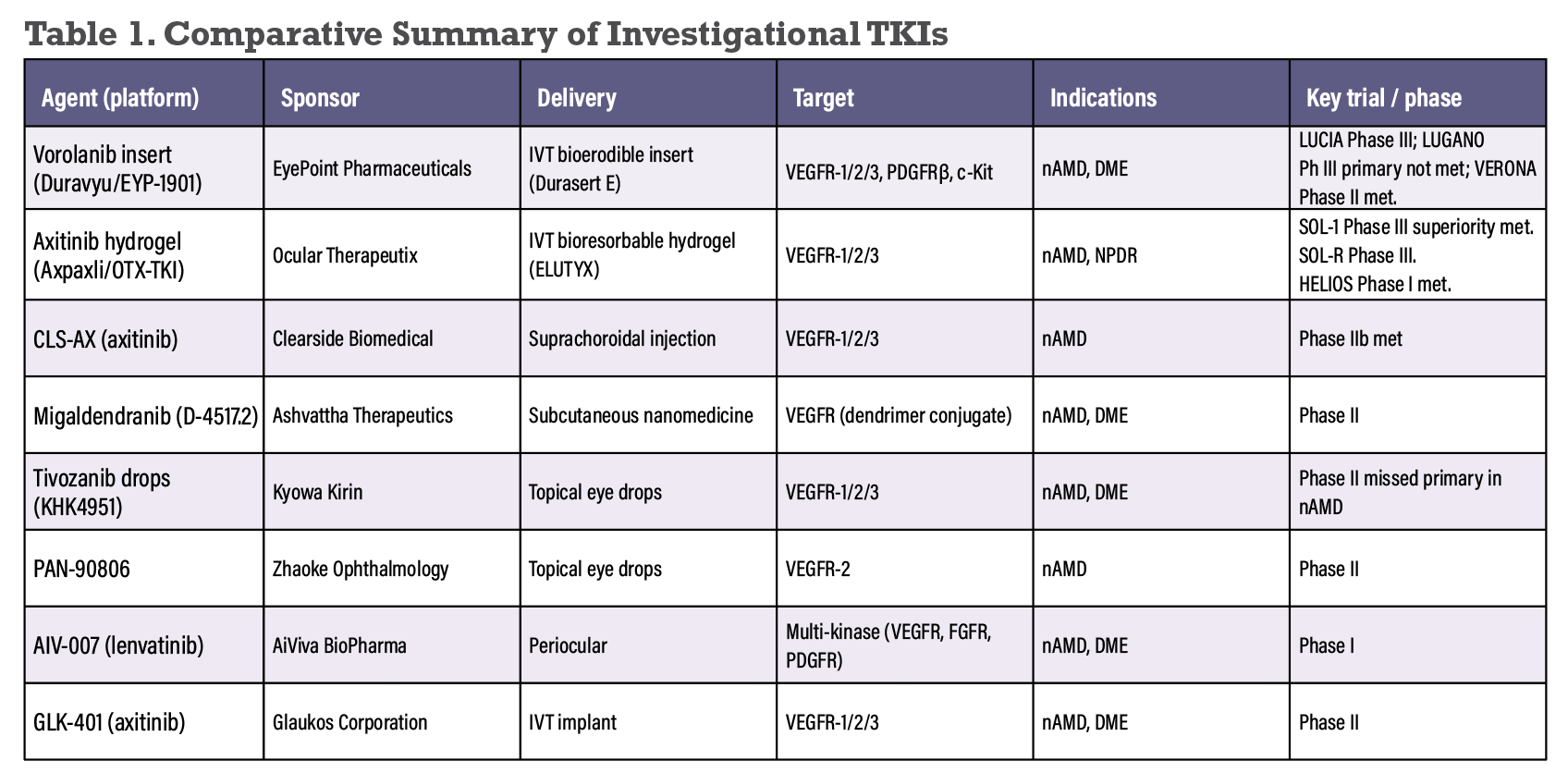 |
| Abbreviations: IVT, intravitreal; nAMD, neovascular age-related macular degeneration; DME, diabetic macular edema; NPDR, non-proliferative diabetic retinopathy; VEGFR, vascular endothelial growth factor receptor; PDGFR, platelet-derived growth factor receptor; FGFR, fibroblast growth factor receptor. Click image to enlarge. |
Intravitreal sustained-release implants
Intravitreal delivery is currently the most popular route of administration, and includes the following implants:
• Vorolanib intravitreal insert (EYP-1901/Duravyu, EyePoint Pharmaceuticals). Duravyu is a bioerodible intravitreal insert combining vorolanib (a multikinase inhibitor of VEGFR-1, -2, -3, PDGFRβ and c-Kit that is structurally related to sunitinib, but spares TIE2 at clinically relevant doses²) with the Durasert E platform, a newer bioerodible version of the Durasert sustained-release technology used in the fluocinolone acetonide insert Iluvien. Duravyu is injected in-office through a 22-gauge needle and is designed to deliver zero-order drug release for at least six months, without the need for refrigeration.5
In the Phase II DAVIO 2 trial, 161 previously treated patients with nAMD received three monthly aflibercept 2 mg loading doses and were then randomized 1:1:1 to a single intravitreal injection of vorolanib 2 mg, a single injection of vorolanib 3 mg or continued aflibercept 2 mg every eight weeks.6 Both vorolanib doses demonstrated noninferior best-corrected visual acuity and central subfield thickness compared with aflibercept, with an approximately 80-percent reduction in treatment burden. At 14 months, 43 percent of the 2-mg arm and 46 percent of the 3-mg arm remained supplement-free.6
Two Phase III trials, LUGANO and LUCIA are evaluating Duravyu 2.7 mg on a six-month redosing schedule against on-label aflibercept in treatment-naïve and previously treated nAMD.7 In
LUGANO, Duravyu didn’t meet the primary vision endpoint for non-inferiority to aflibercept in the overall population, though it did successfully cut the required number of injections. Non-inferiority was only achieved in an ad hoc analysis that omitted a small patient subgroup.
The Phase II VERONA trial in DME met its primary endpoint, with 73 percent of patients in the Duravyu 2.7-mg arm supplement-free through week 24 versus 50 percent in the aflibercept arm, alongside BCVA gains of approximately +7 letters and CST reduction of -90 µm at week four.8 Phase III trials in DME (COMO, CAPRI) are initiating enrollment. The Phase II PAVIA trial in moderate-to-severe nonproliferative diabetic retinopathy didn’t meet its primary endpoint of ≥2-step DRSS improvement at nine months. Disease stabilization was observed in 86 percent and 80 percent of the 3 mg and 2 mg arms versus 70 percent of sham. EyePoint has subsequently prioritized DME (COMO/CAPRI) for Duravyu’s diabetic indication.9
• Axitinib intravitreal hydrogel (OTX-TKI/Axpaxli, Ocular Therapeutix). Axpaxli is a fully bioresorbable intravitreal hydrogel implant delivered through a 25-gauge needle, designed to elute axitinib over nine to 12 months via the Elutyx platform.¹0 Axitinib is an FDA-approved oral inhibitor used in renal cell carcinoma, with high potency against VEGFR-1, -2 and -3.²
In February 2026, Ocular Therapeutix reported positive topline results from SOL-1.¹¹ SOL-1 randomized 344 treatment-naïve patients that achieved 20/20 vision or gained at least 10 ETDRS letters with CST of 350 μm or less after an 8-week loading period of two monthly aflibercept injections 1:1 to a single intravitreal injection of Axpaxli 0.45 mg or aflibercept 2 mg. Under the FDA Special Protocol Assessment, 74.1 percent of Axpaxli-treated patients maintained visual acuity (defined as losing fewer than 15 ETDRS letters) at week 36, compared with 55.8 percent in the aflibercept arm, a risk difference of 17.5 percent (p=0.0006). The treatment effect persisted at week 52 (65.9 vs 44.2 percent; risk difference 21.1 percent, p<0.0001). This was the first Phase III superiority trial of a TKI in nAMD. Criticisms of the trial design include the selection for best responders and the strict criteria for rescue aflibercept.12
The complementary Phase III noninferiority study (SOL-R) is ongoing, and a separate Phase III program in NPDR has received FDA agreement under a Special Protocol Assessment following Phase III HELIOS data that demonstrated no progression to proliferative diabetic retinopathy or center-involving DME in the OTX-TKI arm versus 37.5 percent of sham controls at 48 weeks.¹3
• Other intravitreal axitinib implants. Additional intravitreal axitinib implants in earlier development include AR-14034 (Alcon), a sustained-release implant in the Phase I/II NOVA-1 trial,14 and GLK-401 (Glaukos Corporation), an axitinib implant in Phase II trials for both nAMD and DME.
Alternative delivery routes
There are also potential therapies that don’t use the intravitreal route:
• Suprachoroidal axitinib injectable suspension (CLS-AX, Clearside Biomedical). CLS-AX is a suprachoroidal injectable suspension of axitinib, the same VEGFR-1, -2, -3 inhibitor used in Axpaxli, delivered to the suprachoroidal space via Clearside’s SCS Microinjector for nAMD. Suprachoroidal delivery via Clearside’s microneedle compartmentalizes drug to the choroid and outer retina while limiting anterior segment exposure. In the Phase IIb ODYSSEY trial (n=60, randomized 2:1 to CLS-AX 1 mg or aflibercept 2 mg), CLS-AX demonstrated stable BCVA and CST noninferior to aflibercept every eight weeks, with an 84-percent reduction in supplemental anti-VEGF injections and approximately 67 percent of patients requiring no rescue therapy through six months.15 A Phase III program is planned following an end-of-Phase II meeting with the FDA. The exact execution of the Phase III program will be up to the Health Ocean Pharma company, which is in the process of acquiring Clearside’s assets as part of Clearside’s Chapter 11 bankruptcy filing.
 |
• Periocular lenvatinib gel depot (AIV-007, AiViva BioPharma). AIV-007 (lenvatinib, AiViva BioPharma) is administered as a periocular flowable gel depot of a broad-spectrum TKI (targeting VEGFR-1, -2, -3, PDGFR, FGFR, RET and c-Kit) and is in Phase I trials for nAMD and DME.16 In a preliminary readout of the 18-patient Phase I trial, BCVA improved by up to 16 letters at 84 days, declining to up to four letters by 168 days, with stable or improved CST in the four patients completing 168 days.16
• Topical TKIs. Two topical TKIs are in active Phase II development. KHK4951 (tivozanib eye drops, Kyowa Kirin) is a nano-crystallized formulation of the FDA-approved oral TKI tivozanib (a selective inhibitor of VEGFR-1, -2 and -3), dosed topically for nAMD and DME.17 A Phase I dose-escalation study in Japan (116 patients across three cohorts, including 28 patients with nAMD) demonstrated CST reductions of 27 to 44 µm across dose levels in the nAMD cohort, with BCVA stability.17 Reversible punctate keratitis was observed in 14 percent of nAMD patients and 47 percent of the healthy multi-dose cohort. The drop missed the primary endpoint in its Phase II trial.
PAN-90806 (Zhaoke Ophthalmology) is a selective inhibitor of VEGF-receptor signaling in Phase II testing as a once-daily topical drop. In a Phase I/II dose-ranging trial of 51 treatment-naïve patients with nAMD, more than half completed 12 weeks without requiring rescue intravitreal anti-VEGF injection.18 Corneal adverse events occurred in 9.8 percent of patients.
• Subcutaneous migaldendranib (D-4517.2, Ashvattha Therapeutics). Migaldendranib is a combined TKI and conjugate complex. It’s a 4-nm hydroxyl dendrimer scaffold covalently linked to 7 to 8 sunitinib-analog VEGFR/PDGFR TKI molecules.19 The molecule is designed to cross the blood-retinal barrier following subcutaneous injection and selectively accumulate in activated microglia, macrophages and hypertrophic RPE within sites of choroidal neovascularization. The agent is renally cleared, which avoids the hepatic toxicity associated with oral TKIs.19 Interim 24-week Phase II data including 19 patients showed a 69-percent reduction in supplemental anti-VEGF injection burden in the nAMD cohort and 77 percent in the DME cohort. Among DME patients, mean BCVA improved by +4.5 letters and mean CST improved by -69 µm at 24 weeks.20 In the nAMD cohort specifically, a separate analysis of eight completing patients reported a 79.9-percent reduction in treatment burden, +3 BCVA letters and -45.5 µm CST at 24 weeks.4
Safety considerations
No cases of severe intraocular inflammation, occlusive retinal vasculitis or endophthalmitis have been reported across the intravitreal TKI programs.³ Implant migration into the anterior chamber hasn’t been observed in clinical trials to date for either Duravyu or Axpaxli. In contrast, topical TKI formulations have demonstrated dose-dependent corneal epitheliopathy. Long-term safety data beyond two years remain limited for all TKI modalities.
Bottom line
TKIs may offer sustained treatment of retinal vascular diseases. Between the SOL-1 readout and the upcoming SOL-R and LUCIA results, patients may have more treatment options in the future. Suprachoroidal, periocular, topical and subcutaneous approaches may add further options but remain earlier in development. Future considerations include real-world durability against faricimab and aflibercept 8 mg treat-and-extend regimens, long-term safety beyond two years and performance in refractory disease. RS
REFERENCES
1. Okada M, Mitchell P, Finger RP, et al. Nonadherence or nonpersistence to intravitreal injection therapy for neovascular age-related macular degeneration: A mixed-methods systematic review. Ophthalmology 2021;128:2:234-247.
2. Bakri SJ, Lynch J, Howard-Sparks M, Saint-Juste S, Saim S. Vorolanib, sunitinib, and axitinib: A comparative study of vascular endothelial growth factor receptor inhibitors and their anti-angiogenic effects. PLoS One 2024;19:6:e0304782.
3. Amin R, Kaiser PK. Tyrosine kinase inhibitors for wet age-related macular degeneration: The current developmental landscape. J Pharmacol Exp Ther 2026;393:3:103803.
4. Dhoot DS. Treatment of retinal/choroidal vascular diseases by sustained delivery of vascular endothelial growth factor receptor tyrosine kinase inhibitors. Am J Ophthalmol 2025;277:570-579.
5. Patel S, Storey PP, Barakat MR, et al. Phase I DAVIO trial: EYP-1901 bioerodible, sustained-delivery vorolanib insert in patients with wet age-related macular degeneration. Ophthalmol Sci 2024;4:5:100527.
6. Regillo CD, on behalf of DAVIO 2 and VERONA Investigators. EYP-1901 for retinal exudative diseases: phase 2 DAVIO 2 nAMD end-of-study results and phase 2 VERONA DME results. Presented at: Angiogenesis, Exudation, and Degeneration 2025 (virtual); February 8, 2025. Available at: https://eyepointpharma.com/wp-content/uploads/2025/02/Angio2025_DAVIO-Verona_Regillo_25020501.pdf. Accessed June 2026.
7. EyePoint Pharmaceuticals. EyePoint completes enrollment in phase 3 LUGANO and LUCIA trials of Duravyu in wet AMD [press release]. July 29, 2025.
8. Regillo CD. VERONA: Results from a phase 2 trial of EYP-1901 versus aflibercept for diabetic macular edema. Presented at: Retina World Congress; May 10, 2025; Fort Lauderdale, FL.
9. EyePoint Pharmaceuticals. Topline phase 2 PAVIA trial of Duravyu in non-proliferative diabetic retinopathy [press release]. May 6, 2024.
10. Moshfeghi AA, Khanani AM, Eichenbaum DA, et al. U.S. phase 1 study of intravitreal axitinib implant (OTX-TKI) for neovascular age-related macular degeneration. Invest Ophthalmol Vis Sci. 2023;64:8:936. Abstract presented at: Association for Research in Vision and Ophthalmology Annual Meeting; April 23–27, 2023; New Orleans, LA. 12-month update presented by Khanani AM at: Clinical Trials at the Summit; June 10, 2023; Park City, UT.
11. Ocular Therapeutix. Ocular Therapeutix reports positive results from landmark SOL-1 phase 3 superiority trial in wet AMD [press release]. February 17, 2026.
12. Hsu, Jason. “Is It Ethical?” Retina Specialist, https://www.retina-specialist.com/article/is-it-ethical. Accessed 15 July 2026
13. Do DV, Dhoot DS, Ehlers JP, et al. Phase 1 HELIOS trial of OTX-TKI (axitinib intravitreal implant) for moderately severe to severe non-proliferative diabetic retinopathy: 48-week results. Presented at: Hawaiian Eye and Retina Meeting; January 2025; Kauai, Hawaii.
14. Alcon. Study of AR-14034 in participants with neovascular age-related macular degeneration. ClinicalTrials.gov identifier: NCT05769153. Accessed June 2026.
15. Goldberg RA, Sivaprasad S, Wykoff CC, et al. Phase 2b ODYSSEY trial of suprachoroidal CLS-AX (axitinib injectable suspension) for neovascular age-related macular degeneration. Presented at: American Academy of Ophthalmology Annual Meeting; October 2024; Chicago, IL.
16. Hershoff H, Deecher D, Wang J, Tang-Liu DDS. Periocular injection of AIV007 in the treatment of macular edema due to neovascular age-related macular degeneration or diabetic macular edema: Preliminary results of the phase 1 clinical trial. Invest Ophthalmol Vis Sci 2024;65:7:237.
17. Gomi F, Iida T, Mori R, et al. Phase I study of tivozanib eye drops in healthy volunteers and patients with neovascular age-related macular degeneration. Ophthalmol Sci 2024;4:6:100553.
18. PanOptica. PAN-90806: topline results of a phase 1/2 dose-ranging trial of a topical anti-VEGF eye drop in treatment-naïve neovascular age-related macular degeneration. Presented at: Ophthalmology Innovation Summit at the American Academy of Ophthalmology Annual Meeting (OIS@AAO); October 2019; San Francisco, CA.
19. Ashvattha Therapeutics. Safety and tolerability of a single subcutaneous dose of an anti-angiogenesis drug to treat neovascular age-related macular degeneration (wet AMD) and diabetic macular edema (DME). Poster presented at: Association for Research in Vision and Ophthalmology (ARVO) Annual Meeting; May 2–4, 2022; Denver, CO.
20. Singer MA, Cleland JL. Subcutaneous igaldendranib (D-4517.2) for the treatment of neovascular age-related macular degeneration and diabetic macular edema: interim 24-week results of a phase 2 chronic dosing study. Presented at: MaculArt Meeting; June 2025; Paris, France.